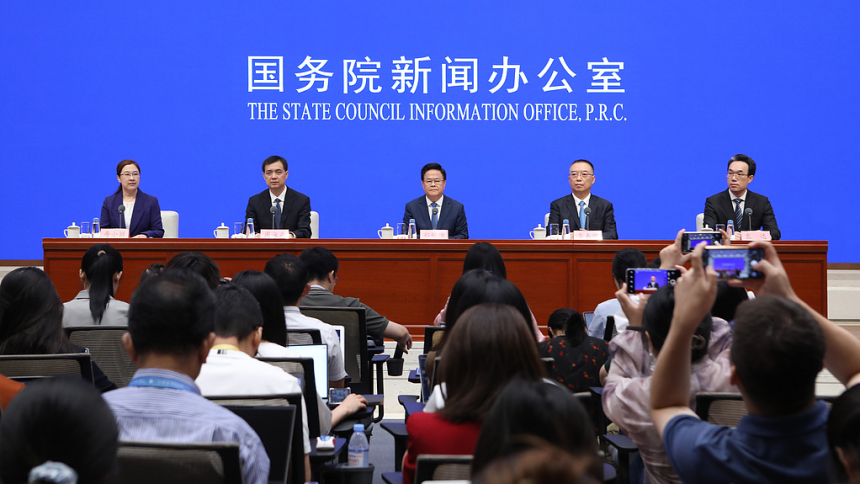
As the 14th Five-Year Plan (2021–2025) enters its final stretch, China is poised to add over 35 trillion yuan roughly $4.89 trillion to its economy, marking a powerful stride in growth despite a turbulent global backdrop. Speaking at a press conference on Wednesday, Zheng Shanjie, head of the National Development and Reform Commission, painted a picture of a country that has not only endured but advanced.
Over the past four years, China’s economy has expanded at an average annual rate of 5.5 percent a remarkable achievement for a nation of its scale, especially amid challenges such as the pandemic and rising external pressures. Zheng described this growth as a global outlier and a sign of China’s underlying economic resilience.
Driving this momentum is an explosion in private enterprise and innovation. From 2020 to May 2025, registered private businesses soared to over 58 million a leap of more than 40 percent while investment in research and development grew by nearly 50 percent, adding 1.2 trillion yuan to national R&D spending. According to Zheng, these gains reflect not just economic performance, but the growing vitality of China’s innovation ecosystem.
Equally important has been the government’s focus on improving everyday life. Today, over 95 percent of the population is covered by basic medical and pension systems. Education, healthcare access, and public transport have all expanded significantly, with high-speed rail networks growing by more than 10,000 kilometers during the plan period boosting mobility, trade, and regional connectivity. Zheng underscored that development must ultimately serve the people, and that every statistical gain should translate into a real difference in daily lives.
Environmental progress is also central to China’s current trajectory. Since 2020, the country has accounted for a quarter of the world’s new greening, pushing national forest coverage beyond 25 percent. Clean energy now makes up more than one-third of all electricity consumption, and water quality in major rivers like the Yangtze and Yellow Rivers has steadily improved, now meeting Class II standards. Zheng emphasized that sustainability is no longer a future goal it’s a current reality shaping policy and practice. “Green is becoming the defining color of high-quality development in China,” he said.
The country has also reinforced its long-term foundations. More than 1 billion roughly 67 million hectares of high-standard farmland has been established or upgraded, helping to guarantee food security. China has also built the world’s largest clean energy system. These efforts have helped slash energy consumption per unit of GDP by 11.6 percent over the past four years equivalent to reducing carbon dioxide emissions by 1.1 billion tonnes, nearly half of the EU’s total in 2024. For Zheng, this represents both a national achievement and a signal of international responsibility.
With less than half a year left in the 14th Five-Year Plan, Zheng expressed strong confidence in China’s current footing and future direction. Institutions are stronger, innovation capacity is growing, and the path to high-quality, people-centered development is clearer than ever. As the country prepares to turn the page to the next planning cycle, Zheng made one thing clear: China isn’t just hitting its targets it’s reshaping what long-term growth looks like.